
Last Updated: October 6, 2026
State Governments Step Up AI Oversight: From the OpenAI Investigation to Bipartisan Governors’ Action
Artificial intelligence governance in the United States is increasingly taking shape not only at the federal level, but also across state governments.
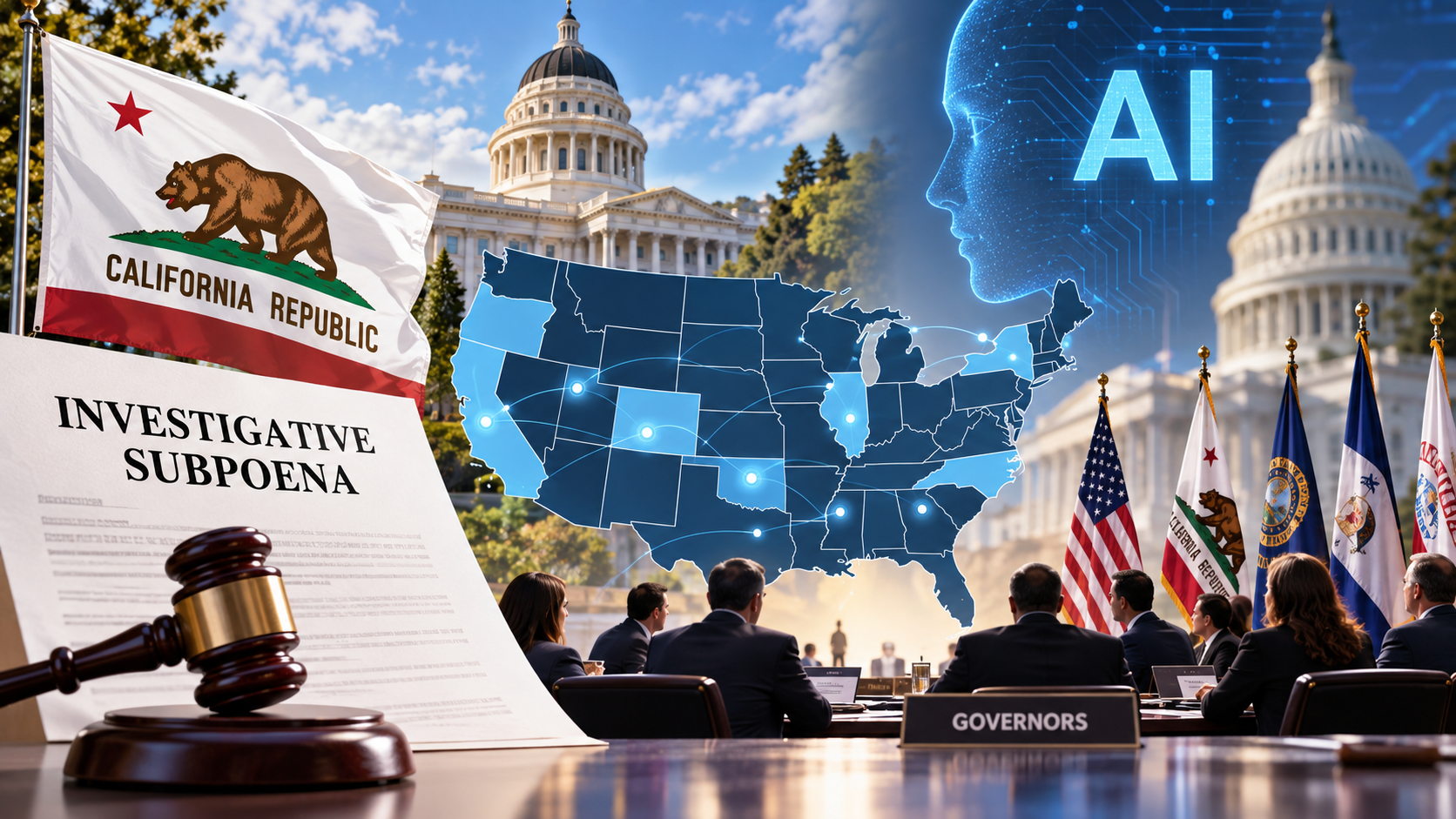
In recent weeks, a bipartisan coalition of attorneys general has urged Congress to establish federal safeguards for large-scale AI models and developers, California has served OpenAI with an investigative subpoena, and Democratic and Republican governors have begun working toward a bipartisan framework for AI policy.
These developments are separate initiatives involving different authorities and processes. Taken together, however, they illustrate the increasingly active role of states in shaping U.S. AI governance.
25 Attorneys General Call for Federal AI Regulation
On September 24, 2026, California Attorney General Rob Bonta joined a bipartisan coalition of 25 attorneys general in urging Congress to take action to regulate large-scale AI models and developers.
The coalition pointed to recent cybersecurity incidents involving frontier AI systems and broader concerns about the potential risks posed by increasingly capable AI models.
Among other measures, the attorneys general called for federal oversight of AI safety testing and standards, transparent government-led incident response, stronger safety infrastructure within AI companies, and international cooperation on advanced AI risks.
Importantly, the coalition also called for any new federal framework to explicitly preserve the authority of states to enact and enforce stronger AI protections.
That issue could become increasingly important as U.S. AI regulation develops: how to create a national baseline while allowing individual states to adopt additional safeguards.
California Serves OpenAI With an Investigative Subpoena
State-level activity is not limited to policy proposals. It is also moving into investigation and enforcement.
On October 1, 2026, California Attorney General Rob Bonta announced that his office had served OpenAI with an investigative subpoena as part of an ongoing California Department of Justice investigation involving incidents resulting from the operations of OpenAI and its AI models.
According to the California DOJ, the subpoena is part of a broader inquiry into cybersecurity incidents and risks involving OpenAI and its models.
The department had previously announced a formal investigation related to a security incident involving OpenAI and Hugging Face.
Bonta said frontier AI models can serve legitimate cybersecurity purposes, but companies developing and deploying them also have responsibilities to ensure that their systems do not perpetrate or enable cyberattacks during development, testing, or deployment.
It is important to distinguish an investigation from a finding of wrongdoing. California has not, through this subpoena, established that OpenAI violated the law. The investigation is intended to gather information and determine whether legal accountability is warranted.
Democratic and Republican Governors Move Toward a Shared AI Framework
A separate development is taking place among U.S. governors.
According to the Associated Press, Maryland Governor Wes Moore announced on October 1 that he is forming a bipartisan group of governors to develop an AI policy framework with Indiana Governor Mike Braun.
Moore, a Democrat, currently serves as chair of the National Governors Association (NGA), while Braun, a Republican, serves as vice chair. The NGA has confirmed their leadership roles for 2026–2027.
Moore argued that while the federal government has an important leadership role in AI policy, governors cannot remain inactive when national policy is not keeping pace with the technology. Other governors from both parties are expected to participate in the effort, according to the AP.
Details of the framework have not yet been finalized publicly. It would therefore be premature to describe the initiative as a new binding regulatory regime. For now, it is better understood as an emerging effort to coordinate state-level approaches to AI governance.
Why State-Level AI Governance Matters
These developments highlight an important feature of the U.S. approach to AI governance.
AI oversight in the United States is not developing exclusively through a single federal AI law or regulator. Federal agencies, Congress, state attorneys general, governors, and state legislatures can all play different roles.
Recent developments show two forms of state action emerging at the same time.
On one side, state law-enforcement officials such as the California Attorney General are using existing legal authorities to investigate AI companies and cybersecurity risks.
On the other, governors are exploring bipartisan coordination around broader AI policy.
At the same time, state officials are not necessarily arguing that states should replace the federal government. The bipartisan coalition of attorneys general called for a federal regulatory foundation while also insisting that states retain the authority to adopt and enforce stronger protections.
One of the key questions for the next phase of U.S. AI governance may therefore be not simply whether AI should be regulated at the federal or state level, but how federal and state authority will interact.
As AI capabilities continue to advance, that federal-state relationship is likely to become an increasingly important part of the U.S. AI regulatory landscape.
Sources:
California DOJ — 25 Attorneys General Call for Federal AI Action
California DOJ — Investigative Subpoena on OpenAI
Associated Press — Bipartisan Governors’ AI Group
National Governors Association — 2026–2027 Leadership