
October 19, 2026 | AI Trends
China Proposes New Export Controls on Advanced AI Technologies
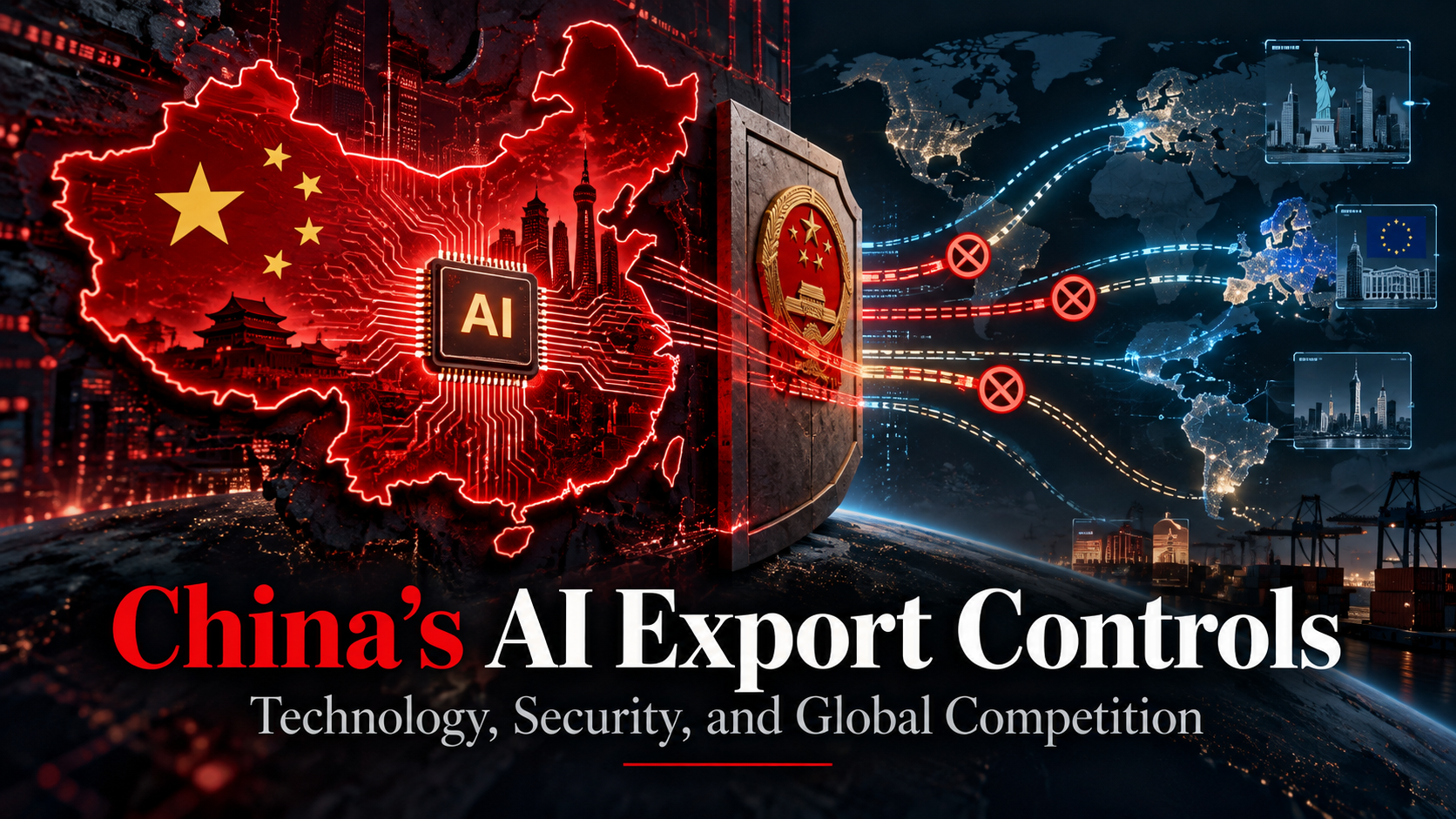
On October 16, 2026, China’s Ministry of Commerce (MOFCOM) and Ministry of Science and Technology (MOST) announced a proposed revision to the country’s Catalogue of Technologies Prohibited or Restricted from Export.
The proposal covers 40 technologies across three sectors: artificial intelligence (AI), biomedicine, and photovoltaics. Of these, 23 are AI-related technologies, including large AI models, AI agents, computing clusters, and information-processing technologies.
The Chinese government proposes prohibiting the export of 14 technologies and restricting the export of another 26. These figures cover all three sectors, not AI alone.
Technologies proposed for prohibition include AI-driven malicious code generation and modification, while technologies proposed for restriction include AI-assisted cybersecurity vulnerability discovery.
Importantly, the proposed export restrictions have not yet been finalized. Public consultation is open until November 15, 2026.
However, a separate temporary pre-export registration requirement covering specified technology transfers took effect on October 16.
Chinese authorities describe the proposal as a measure to safeguard national security and prevent the misuse and uncontrolled proliferation of advanced technologies.
Beyond these stated objectives, the proposal raises broader questions about technological competition, cross-border AI collaboration, and the future of global AI governance.
Which AI Technologies Could Be Affected?
The proposal does not impose a blanket ban on AI technology exports. Instead, it seeks to regulate selected technologies based on defined technical criteria and potential security risks.
The principal AI categories include:
- Large AI models: Core technologies associated with advanced models meeting specified technical thresholds.
- AI agents: Technologies supporting autonomous systems capable of performing complex tasks.
- Computing clusters: Technologies associated with large-scale AI computing infrastructure.
- AI cybersecurity capabilities: Technologies involving automated malicious code generation, modification, and vulnerability discovery.
A key distinction exists between prohibited and restricted technologies.
Technologies classified as prohibited would generally be barred from export, while restricted technologies would be subject to applicable export authorization requirements.
The precise scope of these controls will depend on the final catalogue and its implementing provisions.
What Is Exempt? AI Services, Overseas Deployment, and Open Source
One of the most important aspects of China’s proposed framework is the distinction between transferring core AI technology abroad and providing AI services to overseas users.
According to MOFCOM’s official explanation, transferring a restricted large AI model’s underlying technology for deployment overseas would fall within the scope of technology export controls.
However, deployment on a company’s own overseas cloud infrastructure may qualify for simplified procedures, including automatic licensing.
By contrast, providing overseas users with access to restricted large AI models through APIs, websites, mobile applications, or Software-as-a-Service (SaaS) platforms would not, by itself, fall within the proposed export controls on large-model technology.
China has also proposed differentiated treatment for open-source technologies.
Technologies that have already entered the public domain through open-source releases, academic publications, or similar means would be excluded from the proposed controls.
However, newly releasing a restricted technology as open source may qualify for automatic licensing rather than unconditional exemption.
This approach suggests that China intends to distinguish between international access to AI capabilities and the direct transfer of strategically sensitive underlying technologies.
Why Is China Tightening AI Export Controls?
1. National Security and AI Safety
The Chinese government’s primary stated objective is to prevent advanced AI technologies from being misused in ways that threaten national security.
As AI models become more capable, their potential applications extend beyond productivity and innovation to increasingly sophisticated cybersecurity operations.
Chinese authorities have specifically cited concerns that technologies capable of autonomously generating or modifying malicious code could be used to attack critical infrastructure, defense-related facilities, and sensitive government systems.
The proposed restrictions are intended to reduce the risks associated with transferring such capabilities to malicious actors.
From an AI governance perspective, the proposal illustrates an approach to managing AI risks not only during domestic development and deployment but also during international technology transfers.
2. U.S.–China Competition Over Advanced Technologies
A second important dimension is the broader technological competition between the United States and China.
Since 2022, the United States has introduced export controls targeting certain advanced computing chips and related technologies destined for China.
These measures have evolved over time.
In January 2026, the U.S. Department of Commerce’s Bureau of Industry and Security (BIS) revised its licensing policy to allow applications involving the NVIDIA H200, AMD MI325X, and similar chips to be reviewed on a case-by-case basis, subject to specified security requirements.
China’s latest proposal addresses a different part of the AI technology landscape.
While U.S. export controls have focused significantly on restricting China’s access to certain advanced computing technologies, China’s proposal aims to regulate the overseas transfer of selected technologies developed within China.
Beijing maintains that the revision is part of routine technology trade management and is not directed at any particular country, region, or entity.
Therefore, the proposal should not automatically be characterized as direct retaliation against U.S. restrictions.
Nevertheless, it highlights how advanced AI technologies have become strategically important assets in international economic and security competition.
3. Balancing Global AI Expansion With Technology Protection
China also faces a policy challenge: protecting strategically important AI technologies while allowing domestic companies to compete internationally.
Chinese AI companies have expanded their global presence through large language models, cloud-based services, and AI applications.
Broad restrictions on all AI-related exports could undermine opportunities for international business development and technological cooperation.
The proposed framework addresses this tension by distinguishing direct technology transfers from overseas access to AI services.
It also outlines simplified procedures for certain international activities, including overseas computing infrastructure projects, joint research, and participation in international standards development.
These provisions suggest an effort to maintain international AI collaboration while retaining greater oversight of selected core technologies.
Temporary Pre-Export Registration Is Already in Effect
Although the proposed export prohibition and restriction lists remain under consultation, the temporary registration requirement is already in effect.
Under Announcement No. 48, exporters must register before transferring technologies listed in the proposal during the interim period.
The registration requirement applies to specified activities, including:
- Transferring ownership of technology or intellectual property to an overseas entity.
- Licensing domestic technology for use abroad.
- Changing the owner or actual controller of domestic technology to a foreign entity.
- Other transactions specifically identified by MOFCOM.
Exports that have already begun but have not yet been completed are also covered.
The temporary registration requirement will remain in place until the revised catalogue formally takes effect.
This registration requirement should not be confused with the final export licensing or prohibition regime, which remains subject to the consultation and revision process.
What Could This Mean for the Global AI Industry?
If finalized, China’s proposed controls could create new compliance considerations for international companies that rely on Chinese AI technologies.
The implications may depend on how the technology is obtained and deployed.
For example, accessing an AI model through a cloud-based API could be treated differently from transferring restricted model technology for direct deployment in an overseas data center.
International technology licensing arrangements, intellectual property transfers, research partnerships, and certain cross-border corporate transactions may also require closer scrutiny.
However, the actual commercial impact will depend on the final list of controlled technologies, technical thresholds, licensing procedures, and applicable exemptions.
For international businesses, the distinction between an AI service and a transfer of underlying technology could become particularly important.
A New Dimension of Global AI Governance
China’s proposal illustrates how AI governance is expanding beyond the development and use of AI systems.
Traditional AI governance frameworks have primarily addressed transparency, accountability, fairness, safety evaluation, risk management, and human oversight.
However, as advanced AI models and autonomous systems become more capable, governments are increasingly considering how their underlying technologies should be shared and transferred across borders.
This creates new intersections between AI governance, export controls, international trade policy, and national security.
The emerging policy challenge is not simply whether AI systems are safe to develop and deploy, but also how governments should manage the international movement of advanced AI capabilities without unnecessarily restricting legitimate innovation and cooperation.
China’s proposed framework offers a significant example of this evolving policy landscape.
Conclusion
China’s October 2026 proposal to introduce export controls on 23 AI technologies reflects the growing strategic importance of advanced AI in international technology governance.
The proposed framework distinguishes between the transfer of selected core technologies and the international provision of AI services.
While the final export-control catalogue remains under consultation, temporary pre-export registration requirements are already in effect.
The key developments to watch will be which technologies are ultimately prohibited or restricted, how open-source and overseas service provisions are implemented, and how these rules affect international AI collaboration.
As global AI competition intensifies, AI governance is increasingly becoming not only a question of how AI is developed and used, but also of how advanced AI technologies are shared and transferred across national borders.
Sources
- Ministry of Commerce of China & Ministry of Science and Technology (October 16, 2026). Announcement No. 48 of 2026: Public Consultation on Revisions to the Catalogue of Technologies Prohibited or Restricted from Export and Temporary Pre-Export Registration Requirements.
https://www.mofcom.gov.cn/zcfb/dwmygl/art/2026/art_61446ab4beee4f63973d4d0ab3097648.html - Ministry of Commerce of China (October 16, 2026). Spokesperson’s Q&A on the Proposed Revision of the Catalogue of Technologies Prohibited or Restricted from Export.
https://www.mofcom.gov.cn/zwgk/zcjd/art/2026/art_b11d5c1e9374421e93e85dc87eba6e38.html - Reuters (October 16, 2026). Beijing Seeks Tighter Grip on AI Exports Amid US Rivalry.
https://www.reuters.com/world/asia-pacific/china-proposes-adding-40-ai-biotech-solar-technologies-export-control-list-2026-10-16/ - U.S. Department of Commerce, Bureau of Industry and Security (January 13, 2026). Department of Commerce Revises License Review Policy for Semiconductors Exported to China.
https://media.bis.gov/press-release/department-commerce-revises-license-review-policy-semiconductors-exported-china
Last reviewed: October 19, 2026. This article distinguishes the proposed export-control catalogue from the temporary registration requirement already in effect. The final regulations may differ from the proposal.