
Democratic control of Congress, the Trump administration’s AI policy agenda, and the growing political backlash against AI infrastructure
As of November 5, 2026
1. A New Political Landscape for U.S. AI Governance
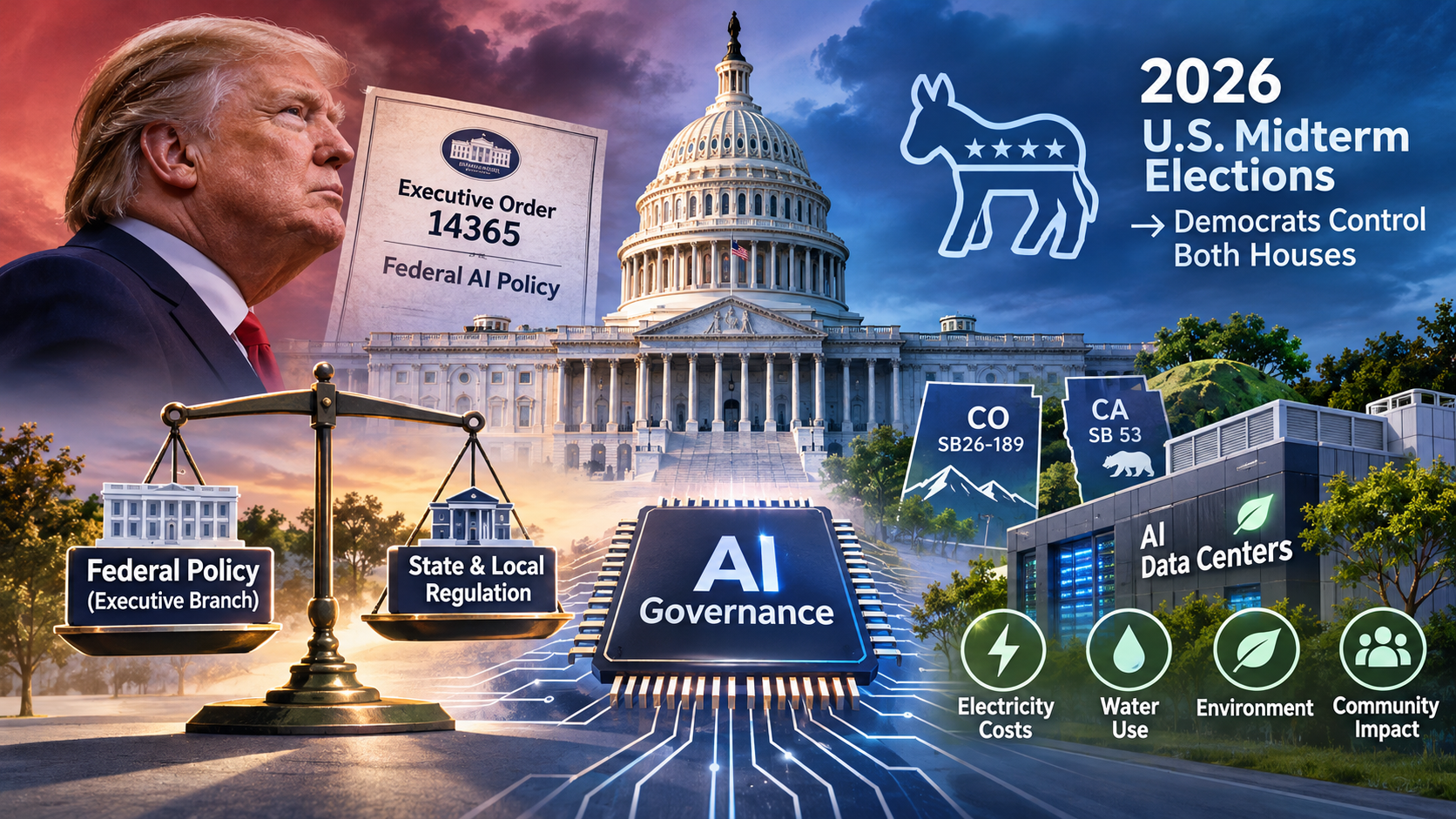
The November 3, 2026, U.S. midterm elections resulted in Democrats securing majorities in both the House of Representatives and the Senate. When the new Congress convenes in January 2027, the United States will enter a period of divided government, with a Republican president and a Democratic-controlled Congress.
The election results could have two significant implications for U.S. artificial intelligence policy.
First, the Trump administration’s efforts to reduce regulatory burdens and establish a more uniform federal approach to AI governance may face stronger congressional opposition and oversight.
Second, growing public opposition to AI data centers, particularly concerns about electricity costs, water consumption, and environmental impacts, could translate into greater political pressure for regulating AI infrastructure.
Although these developments concern different policy areas, they reflect a common trend: the future of U.S. AI governance may increasingly be shaped not only by the federal executive branch but also by Congress, state and local governments, and affected communities.
The election results do not automatically change existing AI laws or invalidate presidential executive orders.
Instead, they alter the political environment in which future AI policies will be developed, implemented, and challenged.
2. Will Trump’s Federal AI Regulatory Strategy Face New Constraints?
Executive Order 14365: Establishing a National AI Policy Framework
On December 11, 2025, President Donald Trump signed Executive Order 14365, Ensuring a National Policy Framework for Artificial Intelligence.
The executive order seeks to establish a more consistent federal approach to AI governance and address state AI laws that the administration considers inconsistent with its national AI policy.
The administration argues that a fragmented regulatory landscape, with different AI requirements across states, could increase compliance costs and weaken U.S. technological competitiveness.
The executive order outlines several measures.
1. Legal challenges to state AI laws
The order directs the Department of Justice (DOJ) to establish an AI Litigation Task Force to identify and challenge state AI laws that may conflict with federal law or constitutional requirements.
2. Federal review of state AI regulations
The Department of Commerce is directed to identify state AI laws that may conflict with federal policy or impose excessive regulatory burdens.
3. Linking federal funding to state AI policies
The order also directs federal agencies to consider linking certain funding decisions to state AI regulatory policies, including aspects of the Broadband Equity, Access, and Deployment (BEAD) Program.
Together, these measures illustrate the administration’s intention to influence state AI regulation through administrative, financial, and judicial mechanisms.
What Changes After the Midterm Elections?
Democratic control of Congress could constrain the administration’s AI agenda in two important ways.
First, passing new federal legislation that broadly limits state AI regulatory authority may become more difficult.
Congress had already demonstrated bipartisan resistance to such restrictions.
On July 1, 2025, the Senate voted 99–1 to remove a provision that would have imposed a ten-year moratorium on certain state AI regulations.
The overwhelming vote showed that opposition to broad federal restrictions on state AI regulation extended beyond Democratic lawmakers.
With Democrats controlling both chambers, similar legislative proposals may face even greater obstacles.
Second, congressional oversight of executive-branch AI policies could intensify.
Democratic-led congressional committees may conduct hearings, request documents, and scrutinize the DOJ’s legal challenges, the Commerce Department’s reviews of state AI laws, and the administration’s use of federal funding conditions.
However, congressional oversight does not automatically terminate executive actions.
President Trump may continue implementing existing executive orders, while the DOJ may pursue litigation within its statutory authority.
The most likely immediate consequence is therefore not the termination of the administration’s federal AI strategy, but greater legislative resistance and congressional scrutiny.
3. The Future of State AI Regulation
While the Trump administration emphasizes a consistent national regulatory framework, several states have developed their own AI laws to address specific risks.
Colorado and California illustrate how state-level AI governance is evolving along different regulatory paths.
Colorado: A Revised Framework for Automated Decision-Making Technology
In 2024, Colorado enacted SB24-205, establishing requirements intended to prevent algorithmic discrimination involving high-risk AI systems.
However, the state subsequently revised its approach.
In May 2026, Colorado enacted SB26-189, which repealed and restructured the earlier provisions and introduced a revised regulatory framework for automated decision-making technology (ADMT).
The new framework is scheduled to take effect on January 1, 2027.
It addresses automated decision-making technologies used in consequential decisions involving areas such as education, employment, housing, financial services, insurance, healthcare, and essential government services.
Key requirements include:
- Developers: Providing technical documentation concerning covered technologies, including intended uses, relevant categories of training data, known limitations, and appropriate use.
- Deployers: Providing certain notices and information to consumers about the use of covered automated decision-making technology.
- Consumer protections: Establishing certain rights concerning access to or correction of personal information and meaningful human review of adverse decisions, subject to statutory conditions.
- Recordkeeping: Maintaining records necessary to demonstrate compliance for at least three years.
These obligations are subject to the law’s specific definitions, thresholds, and exceptions. They do not apply uniformly to every AI system or organization.
Federal Litigation Involving Colorado’s AI Law
In April 2026, xAI filed a lawsuit challenging Colorado’s then-existing AI legislation.
The U.S. Department of Justice subsequently intervened, raising constitutional objections to provisions addressing algorithmic discrimination.
The court later issued a limited enforcement-related order based on an agreement between the parties.
However, that order did not invalidate Colorado’s entire AI regulatory framework.
An important distinction is that the litigation began before Colorado enacted SB26-189.
The relationship between the revised legislation and the existing litigation must therefore be assessed in light of subsequent proceedings and judicial decisions.
Democratic control of Congress does not automatically end DOJ litigation.
Congress may scrutinize the administration’s legal strategy, but the courts retain responsibility for resolving the legal and constitutional questions.
Colorado illustrates why U.S. AI governance cannot be understood solely through election results. State legislation, executive-branch actions, and judicial interpretation all play significant roles.
California SB 53: Frontier AI Safety and Transparency
California adopted SB 53 in 2025, establishing transparency and safety-related requirements for certain developers of frontier AI models.
The law includes provisions addressing public disclosure of safety frameworks, reporting of specified critical safety incidents, and whistleblower protections.
California’s approach differs from Colorado’s.
Colorado’s revised framework focuses on the use of automated decision-making technologies in consequential decisions affecting individuals.
California’s SB 53 places greater emphasis on the development, safety management, and transparency of advanced AI models.
These differences demonstrate that U.S. state AI regulation is not developing around a single regulatory model.
Companies operating across multiple states may face different obligations depending on the technology they develop, the decisions their systems support, and the jurisdictions in which they operate.
What Could Change After the Elections?
Democratic control of Congress may reduce the likelihood of federal legislation broadly preempting state AI laws.
However, state regulations will not become immune from federal legal challenges.
The federal government may continue challenging individual state laws on constitutional or statutory grounds.
Courts will remain central to determining whether particular state requirements are legally enforceable.
As a result, the United States may continue to operate under a fragmented AI regulatory landscape, combining federal policy, state legislation, and judicial decisions.
For businesses, this regulatory fragmentation will remain a significant compliance consideration.
4. A New Political Flashpoint: AI Data Center Regulation
One of the most notable developments surrounding the 2026 midterm elections was the growing political opposition to AI data center development.
Training and operating advanced AI systems require substantial computing infrastructure.
As AI investment has expanded, large-scale data center construction has accelerated across the United States.
However, these projects have also raised concerns about electricity demand, utility bills, water consumption, environmental impacts, and pressure on local infrastructure.
In several communities, those concerns became election issues.
Local Ballot Measures: 46 of 47 Decided Measures Favored Development Restrictions
According to Ballotpedia’s November 4, 2026, reporting, at least 50 local ballot measures related to data centers were scheduled or held during 2026.
Of the 47 measures with determined outcomes, 46 produced results favorable to restricting data center development.
That represents approximately 98% of the decided measures.
The results included both approvals of new restrictions or requirements and rejections of proposals that would have facilitated data center development.
Importantly, these figures cover ballot measures held throughout 2026, not exclusively those decided on November 3.
The results suggest that local concerns about data center development have translated into tangible electoral outcomes.
However, they do not mean that data center construction was legally prohibited in 46 jurisdictions.
Some measures were advisory rather than legally binding, while others concerned zoning, development approvals, or related local decisions.
Their practical legal effects depend on the wording of each measure and subsequent government action.
The broader implication is that communities are seeking greater influence over how and where data centers are developed.
Gubernatorial Elections in Texas and Georgia
Data center development also emerged as an issue in several gubernatorial campaigns.
In Texas, Democrat Gina Hinojosa won the governor’s race, while Democrat Keisha Lance Bottoms won in Georgia.
Both candidates had raised concerns about data center expansion and supported restrictions or temporary pauses on certain developments.
These outcomes attracted attention because Texas and Georgia are important destinations for large-scale data center investment.
However, the election of a governor does not automatically establish a data center moratorium.
Any resulting policy changes will depend on state legislation, permitting rules, utility regulation, and decisions by relevant authorities.
Opposition to Data Centers Is Not Exclusively Democratic
Although Democratic candidates highlighted data center restrictions during the midterm elections, opposition to these projects should not be understood solely as a partisan issue.
Concerns about electricity prices, water consumption, land use, and community impacts have also emerged in Republican-leaning areas.
Some Republican policymakers have likewise called for stronger safeguards or restrictions on data center development.
This suggests that AI infrastructure regulation is increasingly connected to local economic interests, household costs, environmental concerns, and community rights rather than traditional party divisions alone.
The central political question is not simply whether to support or oppose AI development, but how the costs and benefits of AI infrastructure expansion should be distributed.
This could make data center regulation an area of cross-party political pressure, even where policymakers disagree on broader AI regulation.
Financial Market Reactions
Financial markets also responded to the election results.
Reuters reported on November 4 that U.S. equities generally advanced following the Democratic congressional victories, while some data center-related stocks declined amid concerns about potential restrictions on development.
Investors appeared to reassess regulatory risks associated with AI infrastructure expansion.
This does not establish that stricter regulations will necessarily be enacted.
Nevertheless, it illustrates how election outcomes can affect expectations about future regulatory conditions before any formal policy changes occur.
5. Why Data Center Regulation Is an AI Governance Issue
AI governance has traditionally focused on the safety, fairness, transparency, accountability, and reliability of AI systems.
As the AI industry expands, however, the physical infrastructure supporting those systems is becoming an increasingly important governance concern.
Data centers raise at least three major policy questions.
Who Should Bear the Costs of AI’s Growing Electricity Demand?
Large-scale data centers may require substantial investments in electricity generation, transmission, and distribution infrastructure.
A key regulatory question is how these costs should be allocated.
Should data center operators pay the additional infrastructure costs directly, or should some costs be recovered through electricity rates paid by other consumers?
The answer can affect both investment incentives and household energy affordability.
How Much Influence Should Local Communities Have?
Data center projects can affect land use, water availability, noise levels, environmental conditions, and local economic development.
Consequently, zoning decisions, environmental reviews, permitting requirements, and public consultation processes may become increasingly important.
The question is not merely whether AI infrastructure should expand, but whether affected communities have adequate opportunities to participate in decisions about that expansion.
How Should National AI Competitiveness Be Balanced Against Local Interests?
The federal government may prioritize rapid infrastructure development to strengthen U.S. AI competitiveness.
State and local governments, meanwhile, may place greater emphasis on electricity affordability, environmental protection, infrastructure capacity, and community concerns.
These competing priorities demonstrate that AI governance extends beyond the technical risks of AI systems.
It increasingly intersects with energy policy, infrastructure planning, environmental regulation, and democratic participation.
The 2026 midterm elections highlighted the political importance of these issues.
6. Three Potential AI Policy Developments in 2027
The election results suggest three possible directions for U.S. AI governance in 2027.
First: Greater Legislative Gridlock and Congressional Oversight
Democrats will control Congress, but President Trump will retain his veto power.
Consequently, comprehensive AI legislation favored by Democrats may face presidential opposition.
At the same time, proposals supported by the administration to broadly restrict state AI regulatory authority may encounter resistance in Congress.
This could make comprehensive federal AI legislation difficult to enact.
Congressional hearings, investigations, and oversight activities may therefore become more prominent tools for influencing AI policy.
Second: Continued Legal Disputes Over State AI Regulation
The Trump administration may continue using existing executive orders and the DOJ’s legal authority to challenge state AI laws.
States may also continue developing their own consumer protection and AI risk management requirements.
These developments could generate further disputes over federal preemption, constitutional limits, and the scope of executive authority.
Federal courts will remain important in determining the enforceability of individual state AI laws.
Third: Increasing Scrutiny of AI Data Center Development
The strong showing of development-restrictive positions in local ballot measures indicates growing public concern about AI infrastructure.
Because these concerns cross party lines, data center regulation may become an increasingly significant policy issue for both Democrats and Republicans.
Potential areas of debate include electricity infrastructure costs, environmental assessments, disclosure requirements, water use, and community consultation.
However, the adoption and scope of new regulations will depend on state-specific political conditions, statutory authority, and administrative decisions.
7. Implications for Companies Entering the U.S. AI Market
The midterm election results have different implications for AI developers, service providers, infrastructure companies, and investors.
Businesses should distinguish between regulations governing AI models and applications and those affecting the physical infrastructure required to operate them.
AI Developers and Service Providers
AI companies should monitor both federal policy developments and state-specific legal obligations.
Organizations using AI in consequential decisions involving employment, financial services, education, or other sensitive areas may need to assess requirements governing automated decision-making technologies.
Colorado’s 2026 legislative revision illustrates why compliance strategies must be updated as regulatory frameworks evolve.
Developers of frontier AI models should also assess whether they fall within the scope of California’s safety and transparency requirements.
Where litigation affects a state law, companies should distinguish between statutory effective dates, enforcement limitations, and ongoing judicial proceedings.
Data Center Developers and Investors
Data center developers should not evaluate investment conditions solely on the basis of federal policies promoting AI infrastructure.
They should also consider local electricity supply, grid capacity, utility rates, environmental requirements, zoning rules, permitting procedures, and potential community opposition.
For large-scale projects, engagement with local stakeholders and clear allocation of infrastructure costs may become increasingly important.
The emergence of bipartisan opposition to certain data center developments also suggests that political risks cannot be assessed through party affiliation alone.
Implications for South Korean AI Companies
South Korean companies entering the U.S. AI market should develop more differentiated regulatory strategies.
AI software providers should assess applicable state laws based on their services, use cases, and geographic markets.
Companies involved in AI infrastructure or data center development should separately examine energy, environmental, land-use, and local permitting requirements.
Understanding these differences can help companies reduce regulatory uncertainty and improve the predictability of U.S. market entry.
Conclusion: Two Governance Conflicts Are Reshaping the U.S. AI Policy Debate
The 2026 U.S. midterm elections did not immediately change the Trump administration’s AI policies.
However, Democratic control of Congress may make it more difficult for the administration to enact new federal legislation broadly restricting state AI regulatory authority.
At the same time, growing local opposition to data center development has demonstrated that AI infrastructure expansion is becoming a significant political issue.
These developments highlight two distinct but interconnected challenges for U.S. AI governance.
The first concerns the allocation of regulatory authority between federal and state governments.
The second concerns who should bear the economic and environmental costs of AI infrastructure expansion, and who should participate in the decisions governing that expansion.
The fact that opposition to certain data center projects crosses party lines suggests that infrastructure governance may become a lasting feature of U.S. AI policy.
Looking ahead to 2027, understanding U.S. AI governance will require attention not only to federal AI legislation but also to congressional oversight, state-level legal disputes, local permitting decisions, and community responses to AI infrastructure.
The significance of the 2026 midterm elections lies less in an immediate shift toward stricter AI regulation than in the changing political balance over who gets to shape the future of the American AI industry.
References
U.S. Midterm Elections
- Associated Press. (November 3, 2026). Democrats Win the U.S. House and Senate as Voters Deliver a Strong Rebuke to Trump and Republicans.
https://apnews.com/article/f126e12e05b579a327b98481c0ae2226 - Reuters. (November 4, 2026). Democrats Flex Congressional Majorities as Trump Accepts Electoral Losses.
https://www.investing.com/news/politics-news/democrats-flex-congressional-majorities-as-trump-accepts-electoral-losses-5002441
Federal AI Policy
- The White House / Federal Register. (December 2025). Executive Order 14365 — Ensuring a National Policy Framework for Artificial Intelligence.
https://www.federalregister.gov/d/2025-23092 - U.S. Senate Committee on Commerce, Science, and Transportation. (July 1, 2025). Senate Strikes AI Moratorium from Budget Reconciliation Bill in Overwhelming 99–1 Vote.
https://www.commerce.senate.gov/press/dem/release/senate-strikes-ai-moratorium-from-budget-reconciliation-bill-in-overwhelming-99-1-vote-2025-7/
State AI Regulation
- Colorado General Assembly. (2024). SB24-205 — Consumer Protections for Artificial Intelligence.
https://leg.colorado.gov/bills/sb24-205 - Colorado General Assembly. (2026). SB26-189 — Automated Decision-Making Technology.
https://leg.colorado.gov/bills/sb26-189 - Colorado Attorney General. (2026). Artificial Intelligence and Automated Decision-Making Technology.
https://coag.gov/ai/ - U.S. Department of Justice. (April 24, 2026). Justice Department Intervenes in xAI Lawsuit Challenging Colorado’s Algorithmic Discrimination Law.
https://www.justice.gov/opa/pr/justice-department-intervenes-xai-lawsuit-challenging-colorados-algorithmic-discrimination - California Legislature. (2025). SB 53 — Transparency in Frontier Artificial Intelligence Act.
https://leginfo.legislature.ca.gov/faces/billNavClient.xhtml?bill_id=202520260SB53
AI Data Centers and the 2026 Elections
- Ballotpedia. (November 4, 2026). Local Ballot Measure Elections in 2026.
https://ballotpedia.org/Local_ballot_measure_elections_in_2026 - Ballotpedia. (2026). Data Center-Related Ballot Measures, 2026.
https://ballotpedia.org/Data_center-related_ballot_measures,_2026 - Reuters. (November 4, 2026). Trump’s Midterm Drubbing Demonstrates the Power of Data Center Opponents.
https://www.reuters.com/world/us/trumps-midterm-drubbing-demonstrates-power-data-centre-opponents-2026-11-04/ - The Texas Tribune. (November 4, 2026). Gina Hinojosa Won the Governor’s Race. What Happens to Texas Data Centers Now?
https://www.texastribune.org/2026/11/04/data-center-texas-pause-gina-hinojosa-governor-policies/ - Reuters. (November 4, 2026). Wall Street Ends Higher After Democrats Win Congress; Data Center Stocks Tumble.
https://www.fidelity.com/news/article/us-markets/202611041600RTRSNEWSCOMBINED_L6N46L1CJ_1 - Reuters. (November 5, 2026). AI, Data-Center Stocks Slip as Democratic Sweep Clouds Expansion Plans.
https://www.investing.com/news/stock-market-news/ai-datacenter-stocks-slip-as-democratic-sweep-clouds-expansion-plans-5003196
AI Governance and Risk Management
- National Institute of Standards and Technology. (2023). Artificial Intelligence Risk Management Framework (AI RMF 1.0).
https://doi.org/10.6028/NIST.AI.100-1 - National Institute of Standards and Technology. AI Risk Management Framework Resources.
https://airc.nist.gov/