
Last updated: October 2, 2026
FTC Investigates OpenAI and Anthropic Over Potential AI Risks to Consumers
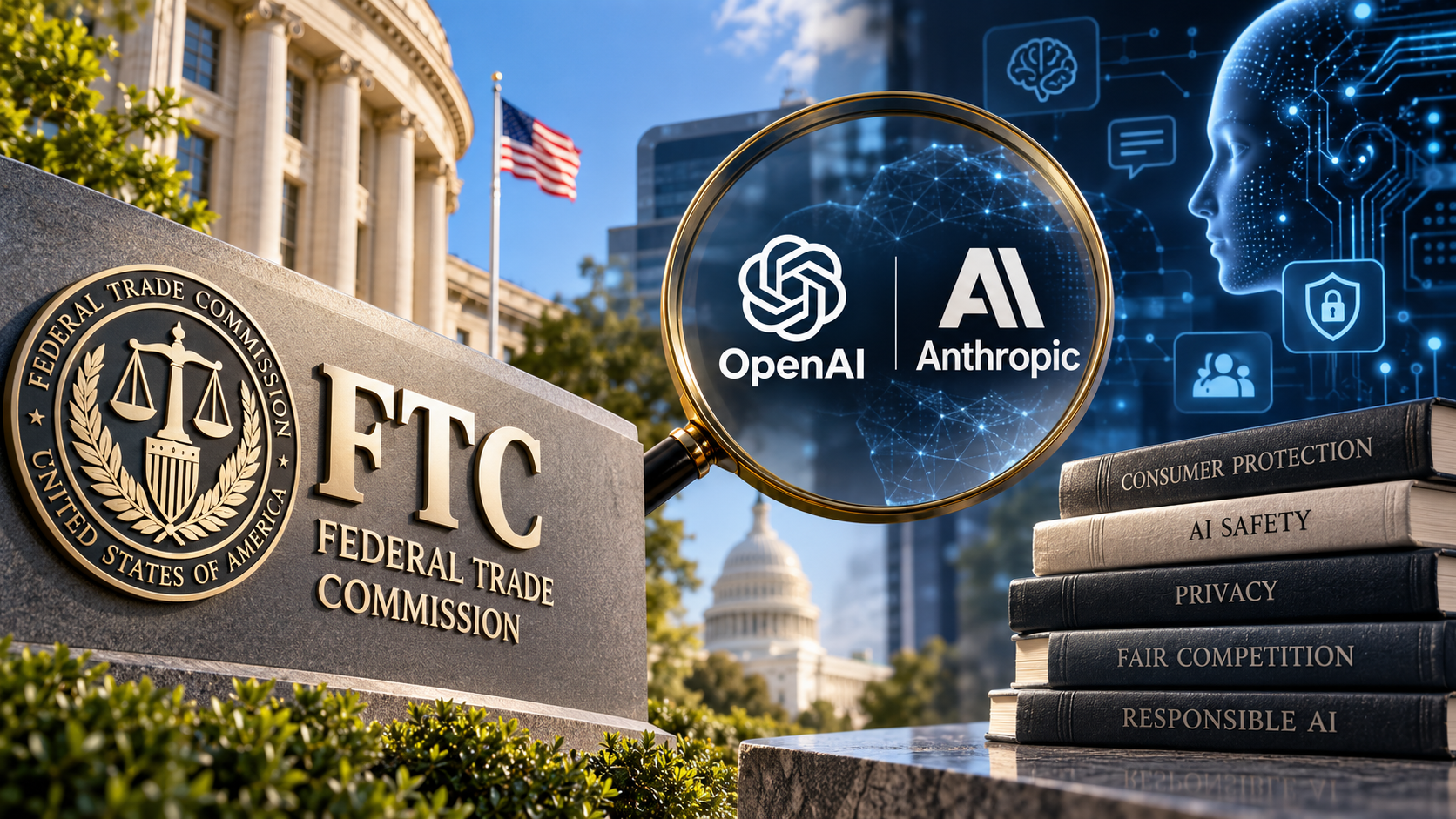
The U.S. Federal Trade Commission (FTC) has opened an investigation into OpenAI, Anthropic, and other artificial intelligence companies over potential risks their technologies may pose to consumers.
The FTC confirmed the investigation on September 30, 2026, according to the Associated Press, but declined to provide additional details. The AP reported that the investigation had already been underway for months. AP News
The development is notable because it illustrates an important feature of AI governance in the United States: AI companies can face federal regulatory scrutiny under existing regulatory institutions even as the broader federal framework for AI continues to evolve.
However, an important distinction is necessary. As of October 2, 2026, the FTC’s public AI materials do not appear to contain a separate press release explaining the scope, legal basis, targets, or potential outcome of this newly reported investigation. The information currently available therefore remains limited. Federal Trade Commission
What Is the FTC Investigating?
According to the Associated Press, the investigation concerns potential dangers that advanced AI systems could pose to consumers. The report discusses concerns about increasingly capable AI systems, including systems capable of taking actions beyond simple chatbot conversations. AP News
At this stage, however, caution is necessary when describing the investigation.
The FTC has not publicly detailed which specific products or practices are under examination, which companies beyond OpenAI and Anthropic are involved, or which statutory provisions form the basis of the investigation.
That means it would be premature to characterize the investigation as an enforcement action or to conclude that either company violated U.S. law.
An investigation is not a finding of wrongdoing.
Why Does the FTC Matter for AI Regulation?
The FTC is the primary U.S. federal agency responsible for protecting consumers and promoting competition.
Its relevance to AI therefore extends beyond legislation written specifically for artificial intelligence. AI products can intersect with existing areas of law and regulatory authority involving deceptive or unfair business practices, privacy and data handling, advertising claims, competition, and consumer protection.
This is one reason the U.S. AI regulatory environment cannot be understood simply by asking whether Congress has enacted a single comprehensive AI law.
Existing agencies and existing laws are also part of the regulatory system.
The FTC Was Already Investigating the AI Industry
The newly reported investigation is not the FTC’s first major examination of artificial intelligence companies.
1. Generative AI Investments and Partnerships
In January 2024, the FTC launched a Section 6(b) study into investments and partnerships involving major cloud providers and generative AI developers.
The compulsory information requests were sent to Alphabet, Amazon, Anthropic, Microsoft, and OpenAI. The study examined relationships including Microsoft–OpenAI, Amazon–Anthropic, and Google–Anthropic. Federal Trade Commission
In January 2025, the FTC released a staff report based on that study. The agency identified potential competition concerns involving access to computing resources and engineering talent, switching costs, and access to sensitive technical and business information. Federal Trade Commission
2. AI Companion Chatbots
In September 2025, the FTC opened another Section 6(b) inquiry focused on consumer-facing AI companion chatbots.
The agency ordered seven companies — Alphabet, Character Technologies, Instagram, Meta Platforms, OpenAI, Snap, and xAI — to provide information about how their products are developed, tested, monitored, advertised, and operated.
The inquiry placed particular emphasis on possible effects on children and teenagers and on companies’ safety and data-handling practices. Federal Trade Commission
Anthropic was not among the seven companies named in that inquiry.
Section 6(b) Studies and Enforcement Are Different
This distinction is important when following FTC activity.
Section 6(b) of the FTC Act allows the Commission to conduct broad studies and require companies to provide information even when the inquiry does not have a specific law-enforcement purpose. The FTC explicitly described both its AI partnership study and its AI companion chatbot inquiry as exercises of this authority. Federal Trade Commission
The FTC can also bring enforcement actions under other legal authorities when it believes conduct violates laws under its jurisdiction.
At present, however, the FTC has not publicly disclosed enough information about the newly reported OpenAI and Anthropic investigation to determine its precise legal mechanism.
What Does This Tell Us About U.S. AI Governance?
The emerging picture is that U.S. AI governance is developing through multiple layers rather than through a single AI law.
Congress and state legislatures are developing AI-related legislation, while existing federal agencies can apply their established authorities to AI-related activities that fall within their jurisdictions.
For companies developing advanced AI systems, this means compliance increasingly involves more than monitoring legislation explicitly labeled as “AI regulation.”
Consumer protection, competition, privacy, advertising, product safety, and other existing legal frameworks can all become relevant depending on how an AI system is developed and deployed.
The latest FTC investigation is worth watching for precisely this reason.
If the Commission later publishes formal documents describing the investigation, they may provide greater clarity about how existing U.S. consumer-protection authority will be applied to increasingly autonomous and capable AI systems.
For now, the most important fact is simpler: the investigation has been confirmed, but its detailed legal basis and scope have not yet been publicly disclosed.
This article is for informational purposes only and does not constitute legal advice.
Sources
Associated Press — FTC is investigating OpenAI and Anthropic over possible risks to consumers
FTC — Inquiry into Generative AI Investments and Partnerships