
AI Policy & Regulation | November 10, 2026
1. Why Did a Pioneer in AI Regulation Rewrite Its Law?
In May 2024, Colorado enacted Senate Bill 24-205, the Consumer Protections for Artificial Intelligence Act, to address the risks of algorithmic discrimination when artificial intelligence systems are used in decisions that significantly affect individuals’ lives.
The legislation was widely recognized as one of the first comprehensive state-level AI laws in the United States. It imposed risk management and anti-discrimination obligations on companies developing or deploying high-risk AI systems.
However, even before the law’s major requirements took effect, Colorado began reconsidering its regulatory framework.
Industry stakeholders raised concerns that the law’s broad scope, risk management requirements, and impact assessment obligations could create substantial compliance costs and legal uncertainty. The allocation of responsibilities between AI developers and the companies deploying their systems also became a central issue.
Colorado responded by postponing implementation and redesigning its regulatory approach.
The key legislative milestones were:
- May 17, 2024: SB 24-205 was signed into law, establishing a comprehensive framework to address algorithmic discrimination in high-risk AI systems.
- August 28, 2025: SB 25B-004 was signed, postponing the implementation of the original law’s major requirements until June 30, 2026.
- May 14, 2026: SB 26-189, Automated Decision-Making Technology, was signed into law, repealing and reenacting the previous provisions under a revised regulatory framework.
- January 1, 2027: The new automated decision-making technology requirements are scheduled to take effect.
These developments do not mean that Colorado has abandoned AI regulation.
Instead, the state has shifted its regulatory emphasis away from broad, proactive corporate risk management requirements toward greater transparency in automated decision-making and rights that consumers can exercise directly.
Colorado’s experience raises a fundamental question: not simply how strictly AI should be regulated, but how regulatory responsibilities should be designed to work effectively in practice.
2. What Changed? From Risk Management to Transparency
The most significant difference between Colorado’s 2024 and 2026 laws lies in their regulatory emphasis.
The original SB 24-205 established a framework centered on high-risk AI systems.
Developers were required to provide information about their systems’ risks and limitations, while deployers faced obligations involving risk management policies, impact assessments, and measures to prevent algorithmic discrimination.
This reflected a preventive regulatory approach designed to identify and mitigate risks before harm occurred.
By contrast, SB 26-189 reorganizes the framework around Automated Decision-Making Technology (ADMT).
ADMT generally refers to technology that processes personal data and uses computation to generate predictions, recommendations, classifications, rankings, scores, or other information used to make, guide, or assist decisions concerning individuals.
However, not every ADMT system is subject to the same regulatory obligations.
The new law focuses on ADMT that materially influences consequential decisions.
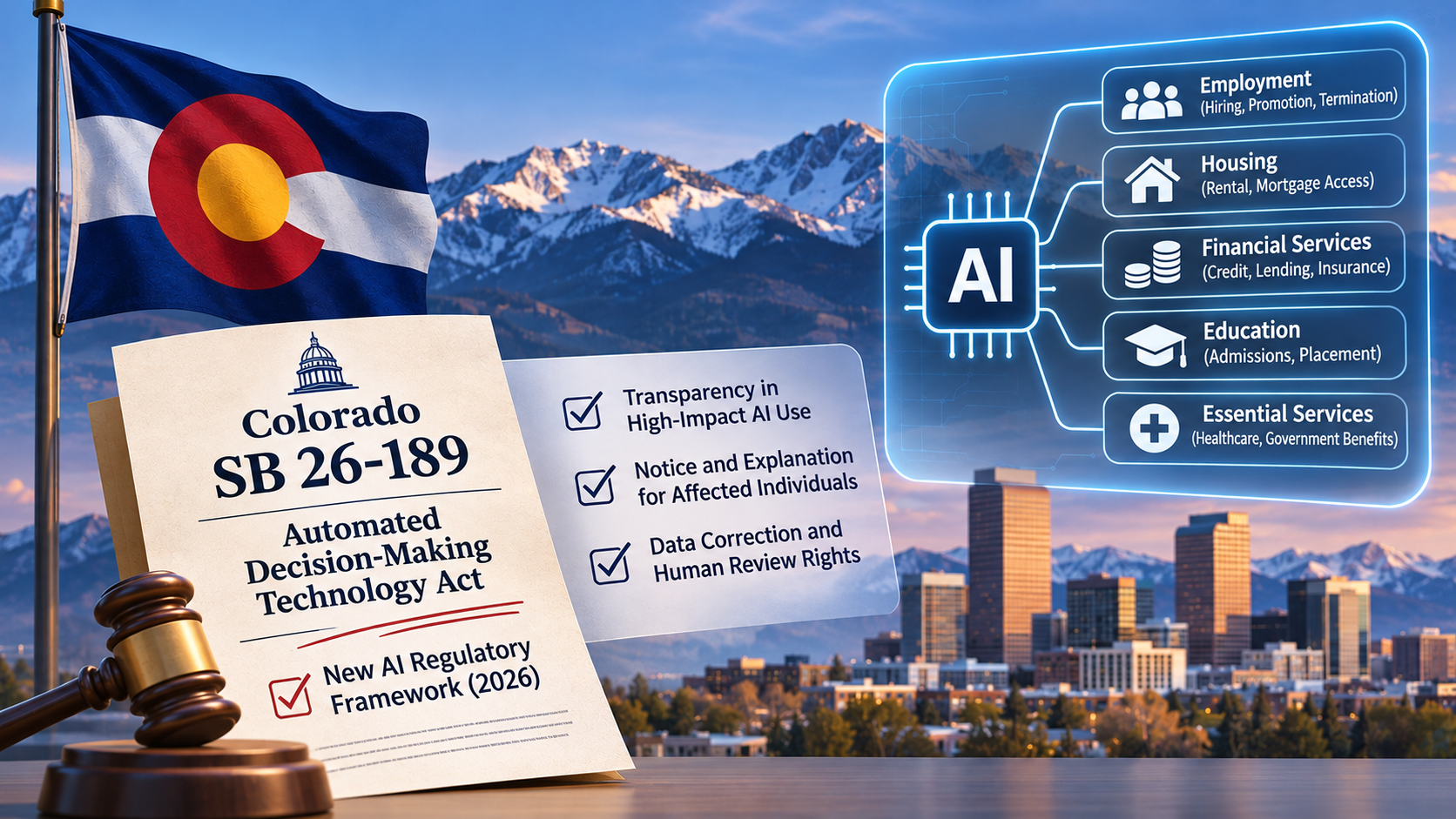
Consequential decisions include determinations relating to an individual’s access to, eligibility for, or compensation associated with employment, education, housing, financial or lending services, insurance, healthcare, essential government services, and public benefits.
Comparing the 2024 and 2026 Laws
| Category | SB 24-205 (2024) | SB 26-189 (2026) |
|---|---|---|
| Primary focus | High-risk AI systems | ADMT materially influencing consequential decisions |
| Regulatory approach | Proactive risk management and anti-discrimination | Transparency, explanations, and consumer rights |
| Developer obligations | Risk disclosures and supporting information | Technical documentation and usage instructions |
| Deployer obligations | Risk management programs and impact assessments | Notices, explanations, correction, and review procedures |
| Consumer protections | Anti-discrimination measures, notices, and related rights | Notices, explanations, data correction, and human review |
| Enforcement authority | Colorado Attorney General | Colorado Attorney General |
| Implementation | Major requirements replaced before implementation | January 1, 2027 |
Importantly, consumer protections were not introduced for the first time in 2026.
The 2024 law already contained provisions addressing consumer notices, correction of personal data, and opportunities for human review under specified conditions.
The 2026 reform is therefore better understood as a rebalancing of regulatory obligations, rather than the creation of an entirely new consumer protection framework.
It reduces certain broad, proactive risk management requirements while placing greater emphasis on transparency and rights consumers can exercise in specific decision-making situations.
3. What Must AI Companies Do?
The new law distinguishes between developers, which create or provide covered ADMT systems, and deployers, which use those systems in consequential decision-making.
Developers: Providing Technical Information and Supporting Responsible Use
Developers of covered ADMT must provide deployers with technical documentation explaining the system’s intended uses, categories of training data, known limitations, and instructions for appropriate use and human review.
Developers must also notify deployers of material updates or modifications to covered systems.
These obligations are intended to reduce information asymmetries between developers and deployers.
Without sufficient technical information, companies using AI systems may struggle to understand their limitations or establish appropriate oversight procedures.
Deployers: Responsibilities Toward Consumers
Deployers are organizations that use ADMT in consequential decisions, such as employment screening, lending, or insurance eligibility.
Where the statutory requirements apply, deployers must provide appropriate notices, explain adverse decisions, and establish procedures for correcting inaccurate personal data and requesting meaningful human review.
Consider a company using an external AI solution to evaluate job applicants.
The AI developer must provide relevant technical information about the system’s intended use and limitations.
The hiring company must determine whether its use of the system falls within the law’s scope and, where applicable, establish the required notice and consumer response procedures.
However, not every AI-assisted recruitment tool automatically triggers the same obligations.
The legal assessment depends on how the technology is used and the extent to which it influences consequential decisions.
Exemptions and Existing Regulatory Frameworks
The law does not impose identical obligations on every AI developer or deployer.
Certain entities already subject to other legal and regulatory requirements may qualify for exemptions or alternative compliance treatment under specified conditions.
Companies must therefore evaluate the technology’s functions, intended uses, influence on consequential decisions, and any applicable statutory exemptions.
Developers and deployers are also required to retain records necessary to demonstrate compliance for at least three years.
These provisions illustrate that AI compliance is not merely a matter of evaluating model performance.
It also requires information sharing, documentation, operational controls, and a clear allocation of responsibilities across the AI supply chain.
4. What Rights Do Consumers Have?
A central feature of Colorado’s revised framework is its emphasis on rights that individuals can exercise when automated decision-making affects consequential outcomes.
Four protections are particularly important.
① Notice of ADMT Use
When a deployer uses covered ADMT that materially influences a consequential decision, it must provide clear and conspicuous notice to consumers at the point of interaction with the covered technology.
However, this requirement does not apply uniformly to every AI application.
The key question is whether the technology materially influences a consequential decision affecting an individual.
Two hypothetical examples help illustrate the distinction.
Example 1: AI in Recruitment
Company A uses AI to support its recruitment process.
If AI is used only to schedule interviews or provide applicants with information about hiring procedures, those functions do not themselves determine whether an applicant is hired.
The situation changes if AI analyzes résumés, assigns suitability scores, and those scores materially influence which applicants are invited to interviews or rejected.
In that case, the system may qualify as covered ADMT because it materially influences an individual’s employment opportunities.
The employer would need to assess its obligations under the law.
Example 2: AI in Lending Decisions
Bank B uses an AI chatbot to answer customer questions.
If the chatbot simply explains interest rates, loan products, or application procedures, its function does not itself determine whether a customer receives a loan.
However, if AI analyzes income, credit history, and transaction records to generate a risk score that materially influences loan approval or rejection, the system may fall within the scope of covered ADMT.
The bank would then need to determine whether the law applies, whether any statutory exemptions are available, and which consumer protection obligations must be fulfilled.
These examples demonstrate that the legal significance of AI depends not merely on the technology itself but on how its outputs influence important decisions affecting individuals.
These are hypothetical examples intended to illustrate the law’s regulatory approach. They do not constitute definitive legal determinations regarding particular AI systems.
② Explanations of Adverse Decisions
When covered ADMT makes a consequential decision resulting in an adverse outcome for a consumer, the deployer must provide a plain-language description of the technology’s role in that decision.
The law requires this description within 30 days following the adverse consequential decision.
For example, if an AI system materially contributes to a decision denying a loan application, the affected consumer may be entitled to an explanation of the system’s role, subject to the applicable legal requirements.
This does not necessarily require disclosure of the AI model’s entire internal architecture or source code.
The precise disclosure requirements must be determined under the statute and applicable implementing rules.
③ Access to and Correction of Personal Data
Consumers have the right, within the scope established by law, to request personal data used by covered ADMT and seek correction of factually inaccurate information.
For example, if incorrect income or employment information is used in an automated lending assessment, the consumer may request correction of that information.
This protection is designed to reduce the risk that inaccurate data will contribute to unfair or harmful automated decisions.
④ Meaningful Human Review and Reconsideration
Consumers may request meaningful human review and reconsideration when covered ADMT makes a consequential decision that results in an adverse outcome, subject to statutory conditions.
For example, an applicant rejected through a covered automated hiring process may be able to request human reconsideration of the decision.
However, the law does not establish an unconditional right to appeal every automated decision.
The availability and procedures for review depend on the applicable statutory requirements and exceptions.
Importantly, the existence of consumer rights does not automatically guarantee their effectiveness.
If explanations are excessively technical or human review is merely procedural, consumers may still struggle to challenge harmful decisions.
The effectiveness of Colorado’s new framework will therefore depend not only on whether rights exist, but also on whether consumers can understand and exercise them in practice.
Further Clarification Through Implementing Rules
The detailed compliance procedures under the new law may be further clarified or adjusted through implementing rules adopted by the Colorado Attorney General.
On August 11, 2026, the Attorney General’s Office filed proposed rules. An interim draft was released on October 6, followed by a formal rulemaking hearing on October 26.
As of November 10, 2026, the official rulemaking information reviewed for this article did not confirm that the final rules had been adopted.
Accordingly, detailed criteria for determining the scope of covered ADMT, consumer notice and explanation procedures, personal data correction, and meaningful human review may be further clarified through final regulations and subsequent enforcement guidance.
This article is based on legislation and publicly available rulemaking materials reviewed as of November 10, 2026. Companies assessing their specific compliance obligations should consult the final implementing rules and the latest official guidance once available.
5. Regulatory Rollback or a New Model of Accountability?
Colorado’s 2026 reform reduces certain broad, proactive risk management obligations imposed under the original law.
In that respect, it can reasonably be described as easing some regulatory burdens.
However, it would be inaccurate to interpret the reform as eliminating legal accountability for AI systems.
The revised law continues to impose obligations involving notices, explanations, correction of personal data, human review, and record retention.
Violations are treated as deceptive trade practices under the Colorado Consumer Protection Act, with enforcement authority assigned to the Colorado Attorney General.
The law does not create a new private right of action, but it does not eliminate potential liability under existing anti-discrimination laws.
For enforcement actions initiated before January 1, 2030, the Attorney General must provide a 60-day notice and opportunity to cure an alleged violation when a cure is considered possible.
This procedure does not provide unconditional immunity from enforcement.
Which regulatory approach is more effective?
Proactive risk management can help identify discriminatory patterns and potential harms before AI systems are deployed.
Transparency and consumer rights, by contrast, can reduce certain upfront compliance requirements while enabling individuals to obtain information and challenge adverse outcomes.
Both approaches have limitations.
Extensive preventive obligations may increase compliance costs, while transparency-based approaches may be less effective if consumers lack the knowledge, resources, or practical ability to exercise their rights.
Algorithmic discrimination can also be difficult for individuals to detect based solely on their own outcomes.
Consequently, explanations and reconsideration procedures alone may not be sufficient to prevent every form of discriminatory harm.
Colorado’s reform can therefore be understood as a policy choice seeking a different balance between corporate prevention obligations and enforceable consumer rights.
6. Three Implications for U.S. AI Governance
Colorado’s regulatory shift offers important insights into the evolution of AI governance in the United States.
First, AI regulation must be practically achievable.
Comprehensive risk management obligations can serve important consumer protection objectives.
However, when legal requirements are overly broad or responsibilities are unclear, companies may face substantial uncertainty and compliance costs.
Colorado’s legislative experience suggests that effective regulation requires not only legitimate policy objectives but also clear, enforceable, and operationally realistic requirements.
Regulatory effectiveness should therefore be assessed not simply by the number or strictness of obligations, but also by their clarity, enforceability, and feasibility.
Second, the context of AI use matters as much as the technology itself.
The risks associated with AI cannot be determined solely by a model’s technical characteristics.
The same technology may have very different implications when used to provide general information rather than to influence hiring or lending decisions.
Colorado’s revised law focuses on whether ADMT materially influences consequential decisions.
This reflects the importance of considering how AI is deployed and how its outputs affect individuals, rather than evaluating technology solely by its capabilities or scale.
Third, U.S. states are developing different regulatory models.
Unlike the European Union, which has established a broad cross-sector framework through the EU AI Act, the United States continues to operate through a combination of federal policies, existing laws, and state-level AI legislation.
Colorado emphasizes consumer rights in automated decision-making, while California has developed a different approach that includes transparency and safety obligations for major AI developers.
Colorado’s reform should therefore not be interpreted as evidence that all U.S. AI regulation is moving in the same direction.
Instead, American AI governance can be viewed as an evolving environment in which states are experimenting with different regulatory instruments.
This diversity may encourage policy innovation, but it can also create complex compliance challenges for companies operating across multiple jurisdictions.
For international AI companies entering the U.S. market, understanding federal policy alone is not sufficient.
They must also assess the legal requirements of the states in which their technologies are deployed.
7. Conclusion: The Real Test Is Whether Accountability Works
Colorado’s 2026 AI law reform represents a significant development in U.S. AI regulation.
While the 2024 framework emphasized proactive management of algorithmic discrimination risks, the revised law places greater weight on transparency in automated decision-making and rights that consumers can exercise directly.
However, it remains uncertain whether this shift will improve consumer protection or create new gaps by reducing certain preventive obligations.
Following implementation in January 2027, important indicators will include corporate compliance practices, consumers’ actual use of their rights, and enforcement actions by the Colorado Attorney General.
The final implementing rules and subsequent guidance will also be important in determining how the law operates in practice.
Ultimately, Colorado’s experience demonstrates that the central question in AI regulation is not simply whether governments should impose more or fewer requirements.
The more fundamental question is:
When AI significantly affects people’s lives, who is responsible for preventing harm, explaining decisions, and providing meaningful remedies when something goes wrong?
Effective AI governance requires more than legal declarations of accountability.
It requires responsibilities that can be implemented by companies, enforced by regulators, and meaningfully exercised by individuals.
Colorado’s revised framework represents one policy experiment in the continuing effort to balance technological innovation with consumer protection.
References
- Colorado General Assembly. (2024). SB 24-205: Consumer Protections for Artificial Intelligence.
https://leg.colorado.gov/bills/sb24-205 - Colorado General Assembly. (2025). SB 25B-004: Increase Transparency for Algorithmic Systems.
https://leg.colorado.gov/bills/sb25b-004 - Colorado General Assembly. (2026). SB 26-189: Automated Decision-Making Technology.
https://leg.colorado.gov/bills/sb26-189 - Colorado General Assembly. (2026). SB 26-189: Automated Decision-Making Technology — Signed Act (Full Legislative Text).
https://leg.colorado.gov/bill_files/116489/download - Colorado Attorney General. (2026). Colorado Automated Decision-Making Technology & Chatbot Safety Rulemaking.
https://coag.gov/ai/